Pelloran Inc.
Energy and fusion

Fusion-plasma equilibrium

An example study page, in a provisional format: the fusion pilot.

Benchmark
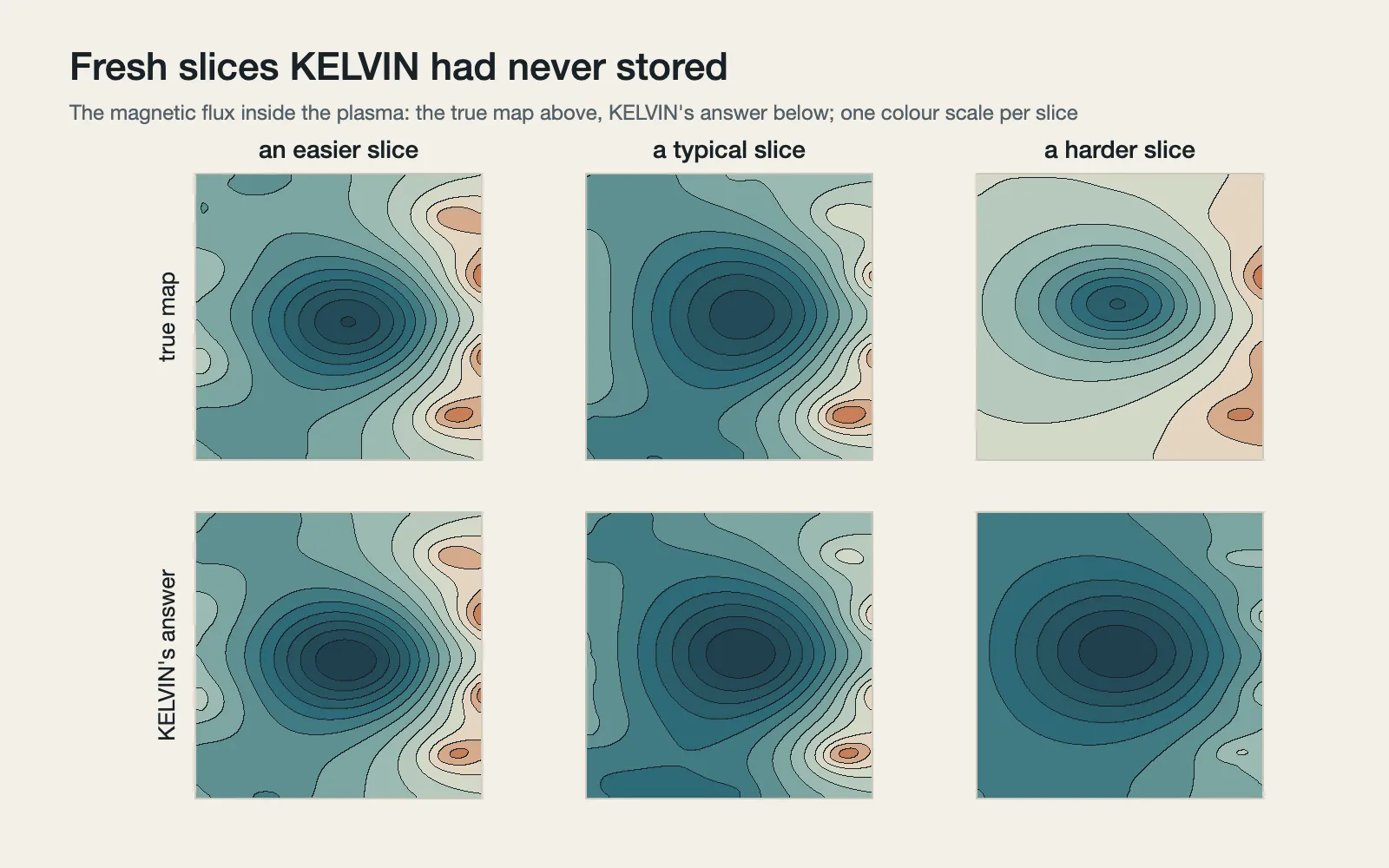
Six contour maps of the magnetic flux in three columns: in each column the true map above and KELVIN's answer below; in the first two columns they look nearly alike, in the third the answer is smoother than the truth.
Three fresh slices KELVIN had never stored, from the plug-in's first sprint: the true magnetic flux map above, KELVIN's answer below. An easier, a typical and a harder slice: the 10th percentile, the median and the 90th percentile of the error over 3 591 fresh slices.

The question

Can an engine reconstruct the magnetic equilibrium of a fusion plasma from its measurements, without being trained on examples first?

The result

Without any training, our engine reconstructs fusion-plasma equilibria on the public test of the DIII-D benchmark at a score of 0.957.

The more data it holds, the higher it scores (0.90 at 1 002 shots, 0.95 at 7 040), where a trained baseline levels off near 0.73.

KELVIN is a general engine; fusion was added as a plug-in, in about six hours of active work. Five days later, its entry placed 6th in the final ranking of the Fusion Equilibrium Challenge (NeurIPS 2026), on CPU only.
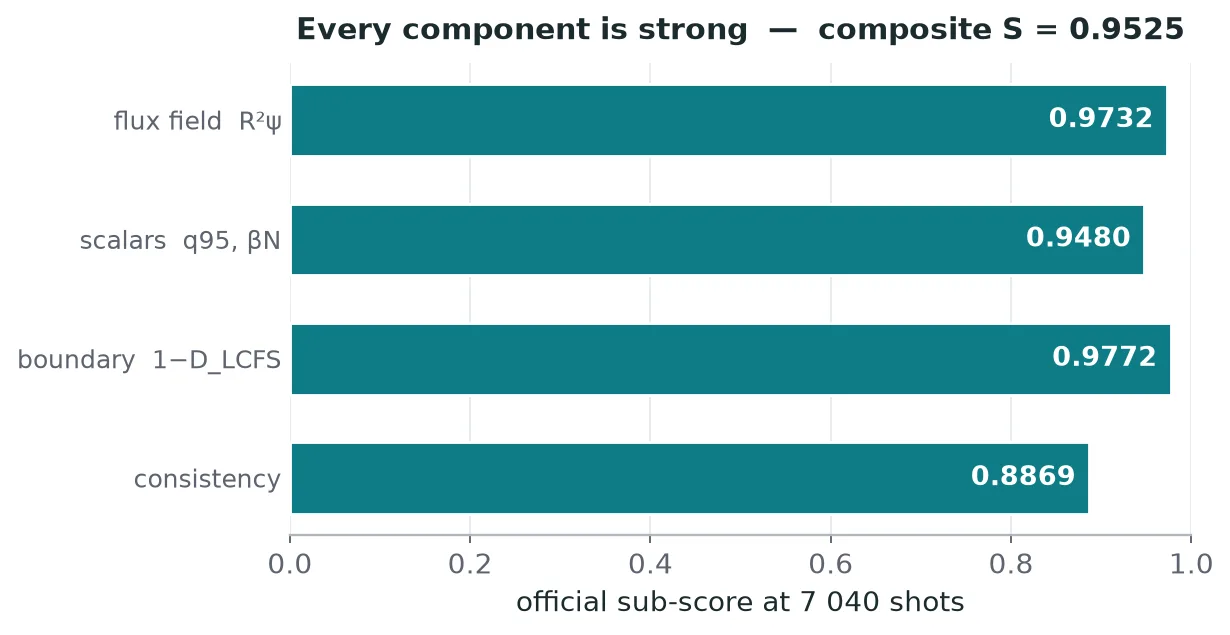
Bar chart of the four parts of the score at 7 040 shots: flux map, the two scalars q95 and βN, plasma boundary and consistency; every bar lies between 0.887 and 0.977.
Where the score comes from, at 7 040 shots: all four parts the challenge scores are high. The flux map 0.973, the two plasma scalars (q95 and βN) 0.948, the plasma boundary 0.977 and the consistency 0.887, weighted together 0.95. Measured on the training set by leaving out one shot at a time.

The control

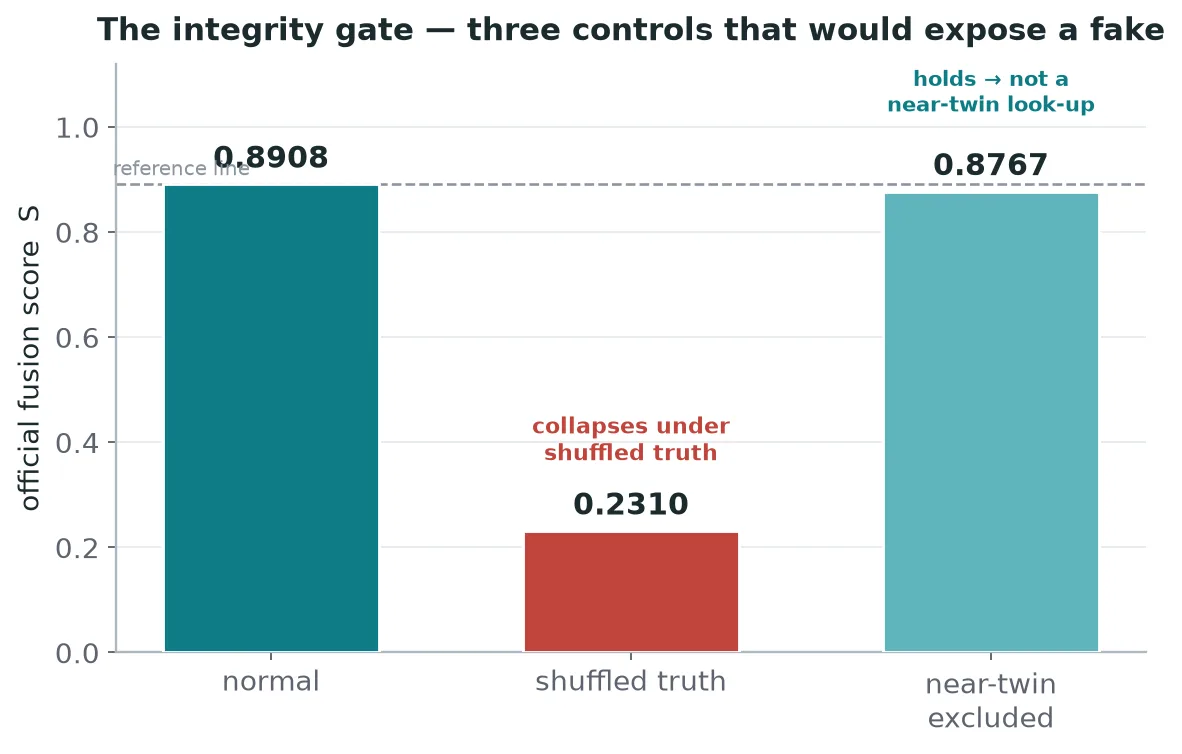
Bar chart of three runs: normal 0.89, stored truth shuffled 0.23 (red, collapsed), near-identical shots left out 0.877.
Controls that would expose a fake, on 1 002 shots with 12 slices each: normally the score is 0.89; with the stored truth shuffled, it collapses to 0.23; with near-identical shots left out, it holds at 0.877. The third control is not drawn: a rerun gives a bit-identical result.

The limit

The public-test score is from the challenge's development phase, with the memory alone. The curve is measured by leaving out one shot at a time on the training set; with near-identical shots excluded, it reaches 0.877.

The control was run on 1 002 shots, with 12 slices each.

Data and licence

The data: the challenge's public dataset, published by Sophelio on Hugging Face under the CC BY 4.0 licence.

Whom to talk to

Questions about this study, or a problem like it in your field: write to us.

Write to us → All studies