
Screening for high-temperature superconductors
How well our engine ranks known superconductors by whether they still work at higher temperatures: a screen, tested on materials it had not seen.
Benchmark
The question
Among materials known to superconduct, can our engine tell from a material's crystal structure and composition which ones still superconduct at higher temperatures?
The result
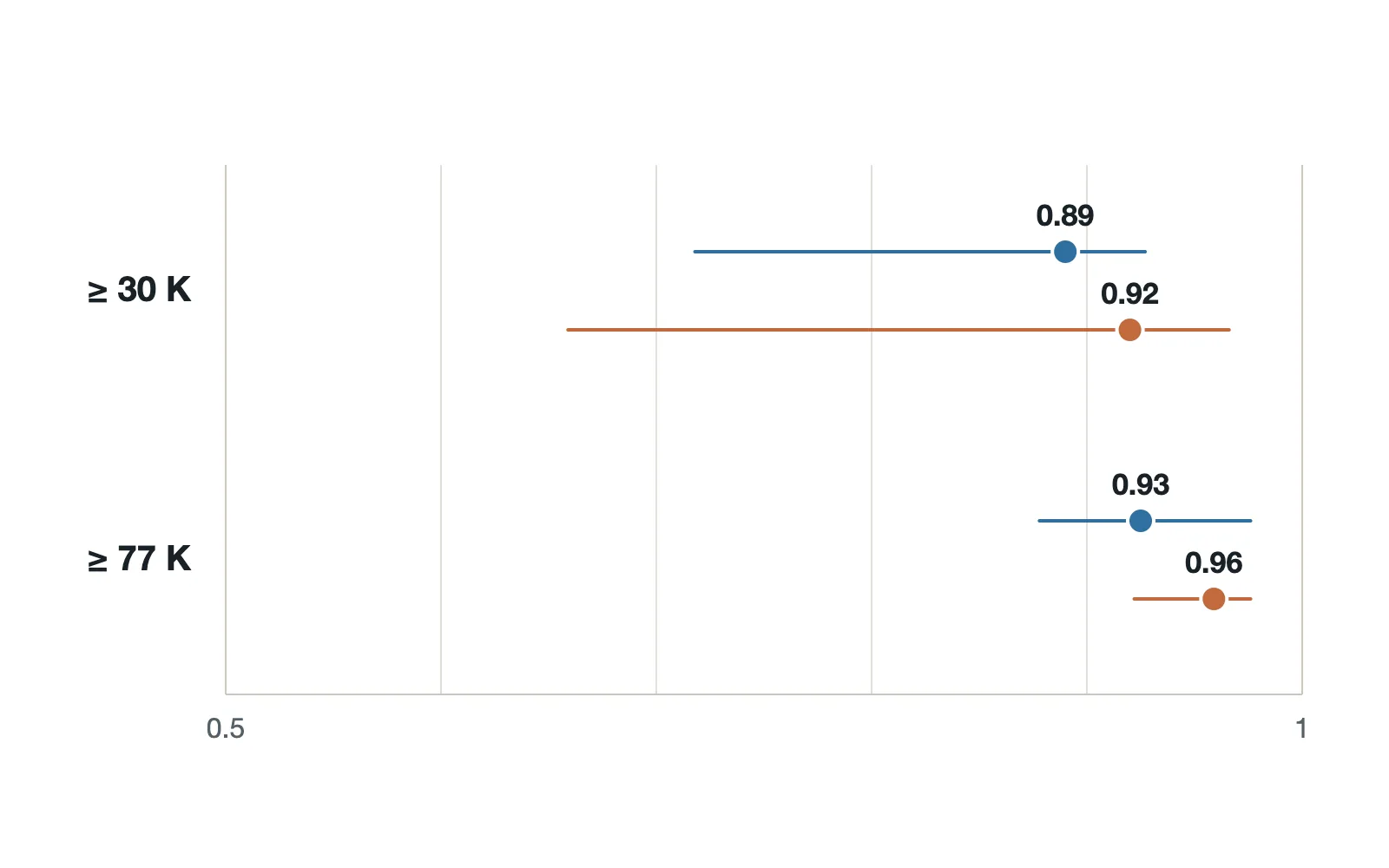
Among 3,884 known superconductors, our engine ranks which ones work above 30 K, and which above 77 K, the temperature of liquid nitrogen. On materials it had not seen, its ranking score is 0.92 for above 30 K and 0.96 for above 77 K, on a scale where 0.5 is a coin toss and 1 is perfect.
Most of that comes from the composition: a simple summary of it alone scores 0.89 and 0.93. Each score is the median of 20 runs.
The control
Each test held out whole families: a material and every variant built on the same parent crystal, doped versions included, always stayed on the same side. Each of the 20 runs held out a fresh random fifth of the families.
On the same 50 splits, adding the structure to the simple summary of the composition raised the score in 40 of them for above 30 K, and in 38 for above 77 K. A coin would do that less than once in a thousand tries.
With the structure data shuffled between materials, its gain disappears. On a test that sorts the superconductors into three temperature classes, the real data adds 4.8 points of accuracy to the simple summary; shuffled, it costs 2.4.
The limit
It is a screen, not a prediction of the exact temperature. It ranks materials already known to superconduct; asked whether a material superconducts at all, it is close to chance (about 0.6, where 0.5 is a coin toss).
Most of the signal is in the composition. Against a stronger model that uses the composition only, built from seven properties of the elements (35 numbers in all), adding the structure brought no measurable gain on the three-class test (−0.05 points), and that model alone scored higher than ours (76.7% against 72.6%).
At 30 K the score moves a lot from run to run: most runs fell between 0.66 and 0.97. Few materials sit at the top: 536 of the 3,884 work above 30 K, and 140 above 77 K. The engine reads the undoped parent crystal, which handicaps materials whose temperature depends on doping. The ranking itself comes from a simple model trained on the materials outside each test.
Data and licence
The data: 3DSC, a public dataset by Sommer and colleagues that pairs measured superconductors from the SuperCon database with crystal structures from the Materials Project. It holds 5,773 materials; 5,622 of them could be read, among them 3,884 superconductors.
The dataset is published under the CC BY 4.0 licence.
Whom to talk to
Questions about this study, or a problem like it in your field: write to us.