
KELVIN Meridian
Learns from one experience. Answers from what it kept. Says so when it was never told.
Your programs ask KELVIN directly, with a key of their own. It needs no training run and no graphics unit, and what it learns stays with it, so a request carries only the question.
A remembered answer
8.7 ms
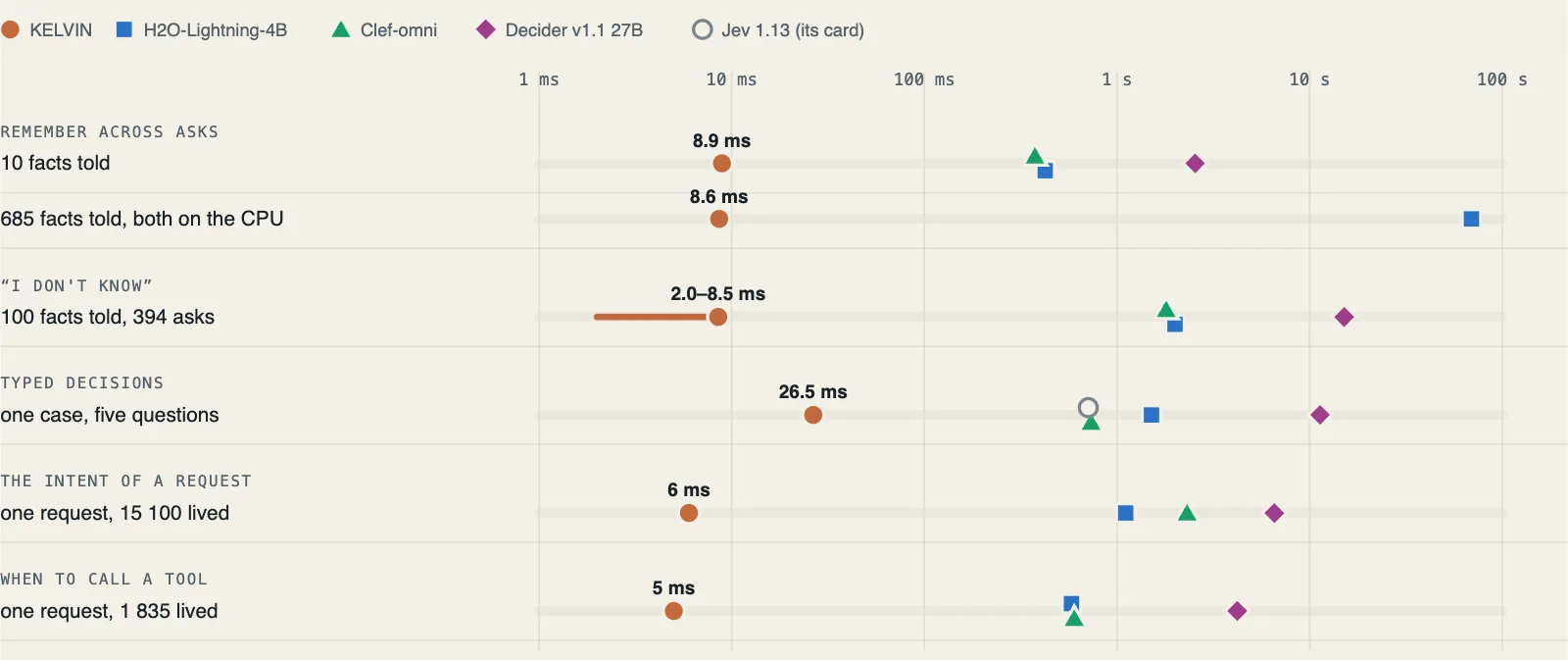
From its own memory, on one Mac, without a network. An open model with everything pasted in: 424 ms at ten facts. Through its own address: about 250 ms with the network.
Wrong answers to the never-told
0
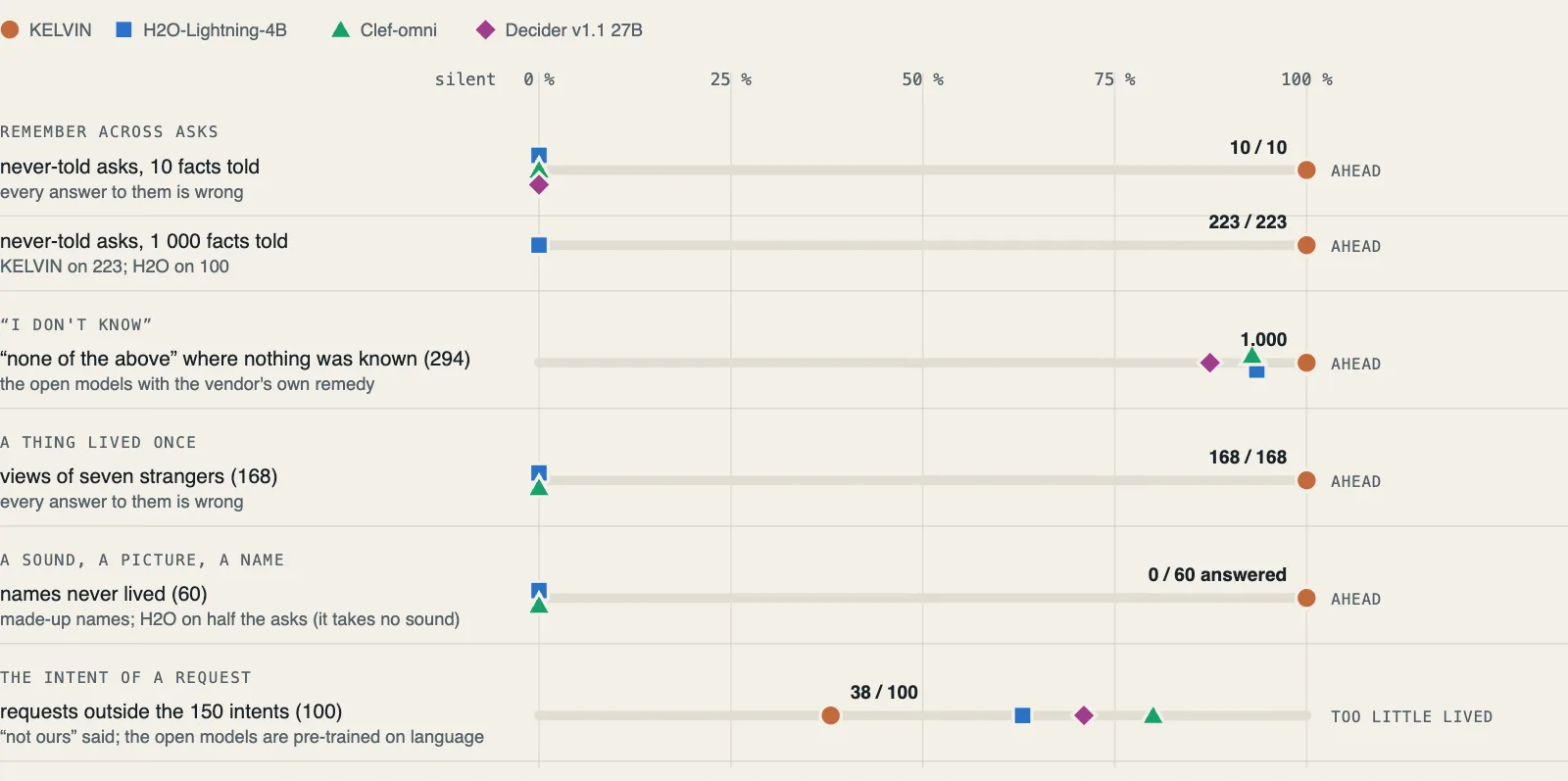
Silent on all 223 asks it was never told. Every open model answered every one, and was wrong every time.
Graphics unit
none
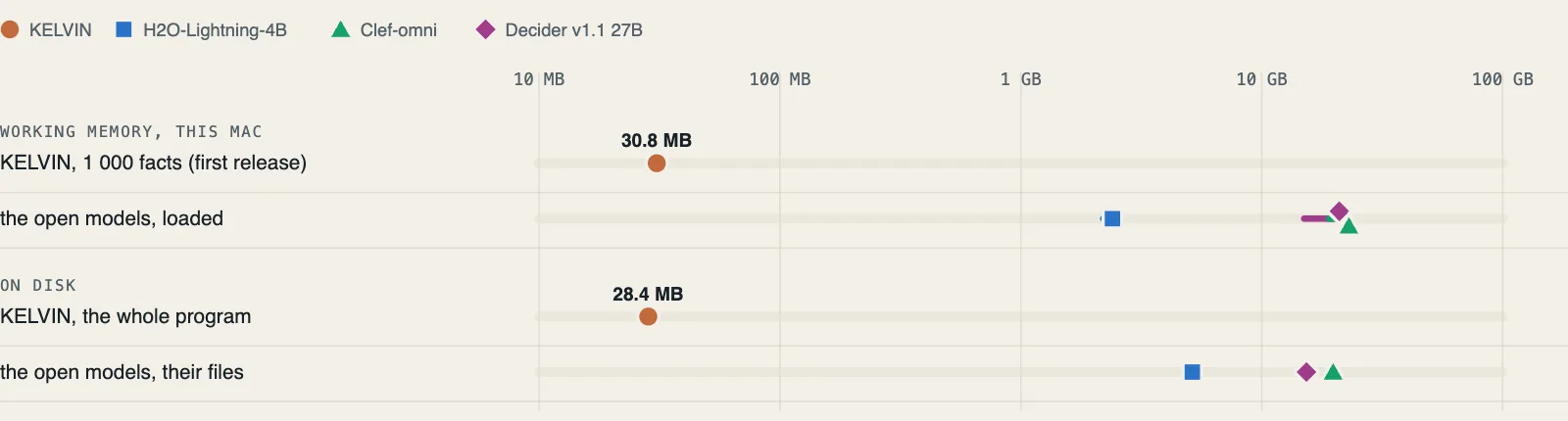
KELVIN runs on the CPU alone. The open models run on the graphics unit.
The whole program
28.4 MB
KELVIN as our servers run it. The open models’ files take 5.15 to 19.78 GB.
What travels with a question
the question
An open model needs all it was told in every request: 339 040 tokens for 15 000 intents, more than any of them can take.
Jev’s own field
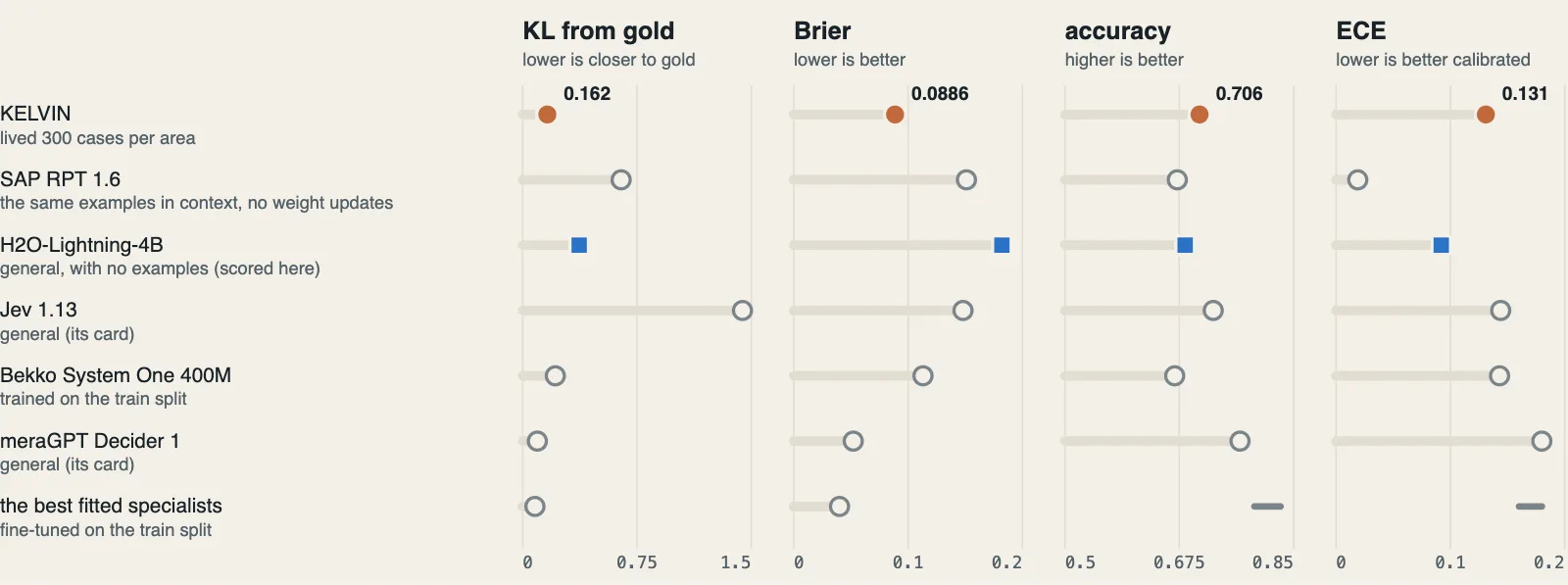
0.706
Typed decisions, by the dataset’s own scorer, with no training: above H2O (0.684), SAP RPT 1.6 (0.672) and Bekko 400M (0.668). Below Jev’s own card, 0.727.
The same asks, the same machine, level by level.
Three open models of Jev’s kind answered the same requests as KELVIN, on one Mac. KELVIN lived each task’s examples once; they came pre-trained.
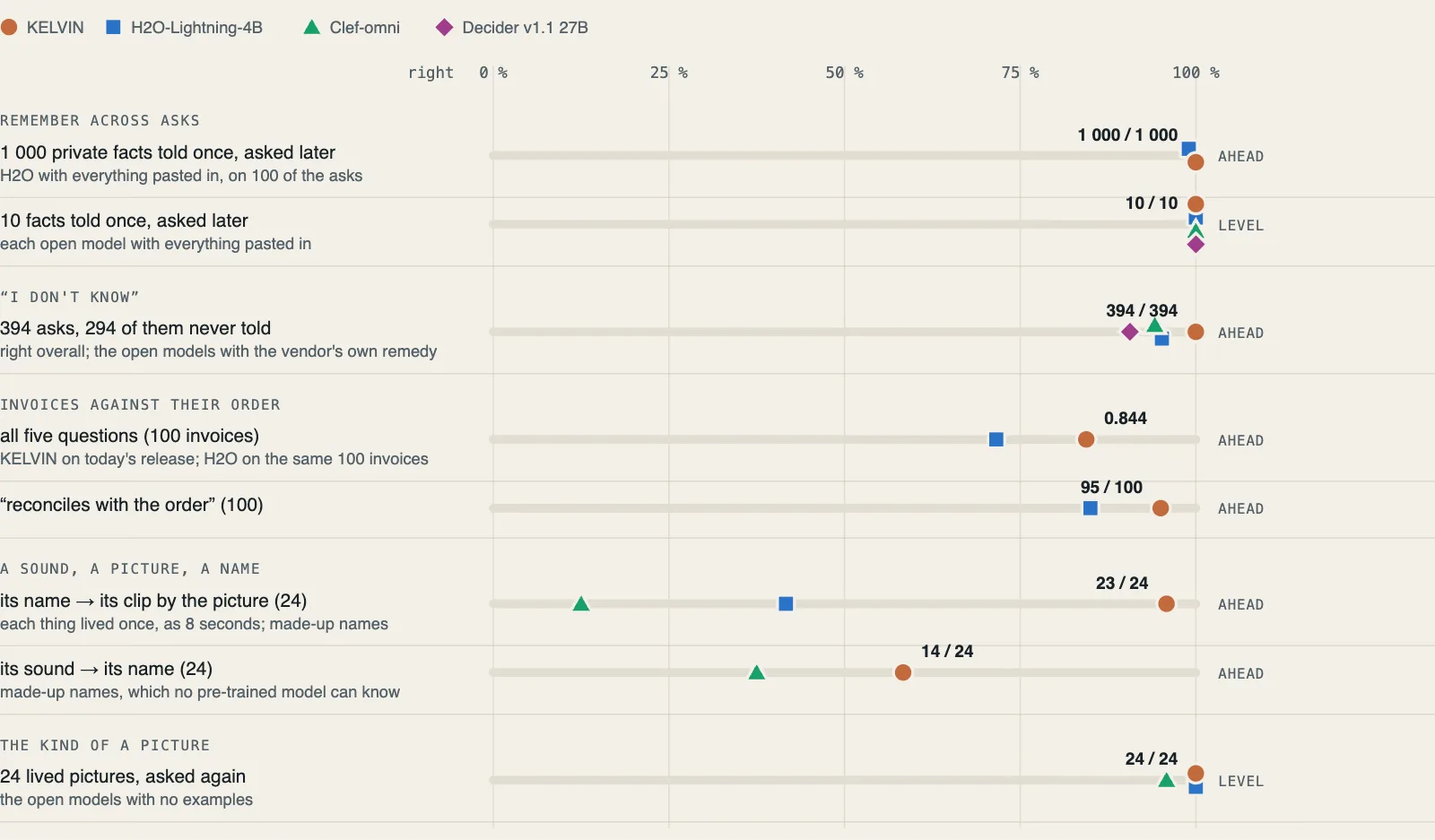
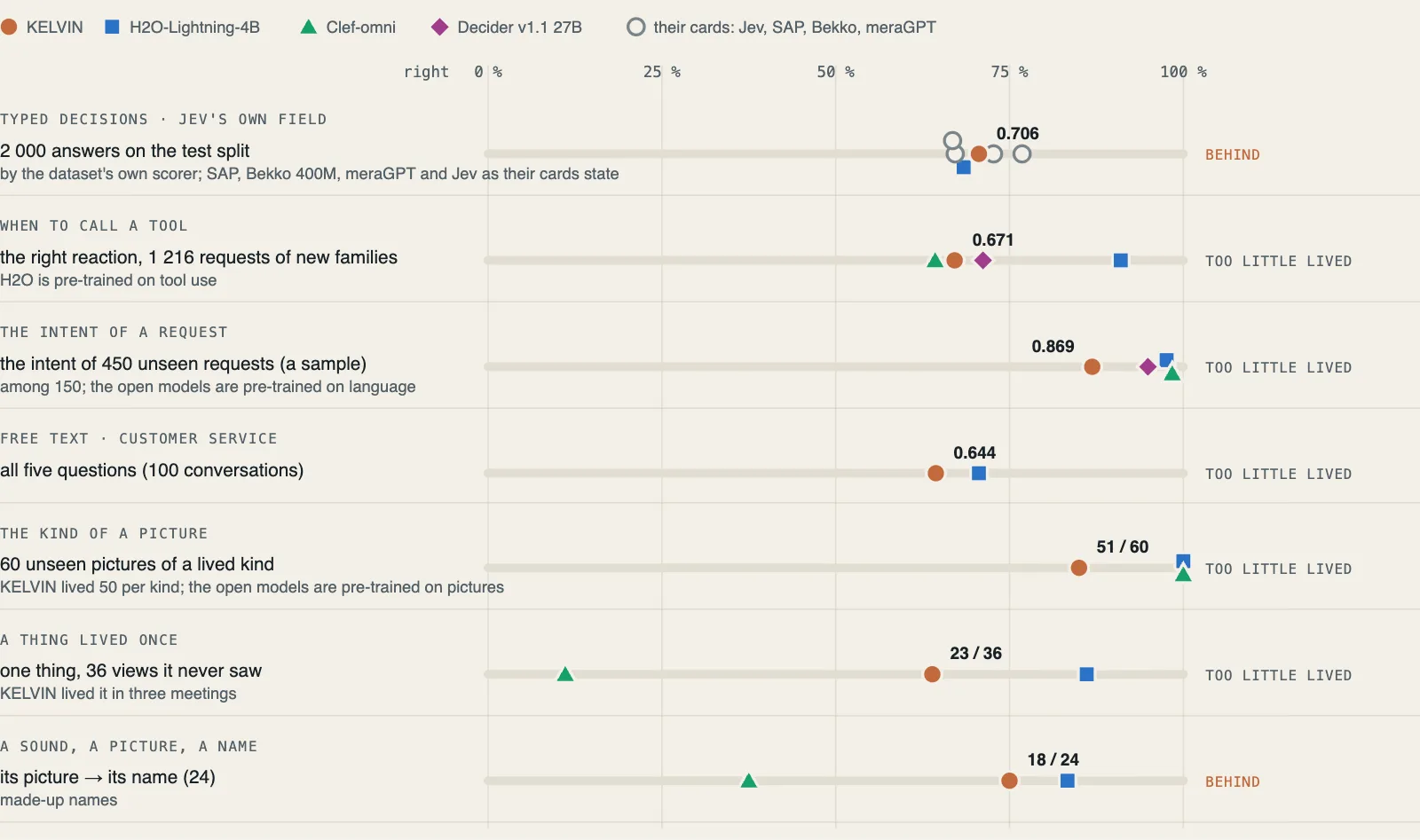
Right, or silent.
How sure, by the dataset’s own scorer.
It learns after the start, and keeps it.
A pre-trained model is fixed once it ships. KELVIN learns from one experience and keeps it.
1 000 / 1 000
Told once, kept
Private facts no training could hold, answered later from its own memory.
15 416 / 15 416
Survives a restart
Across 32 restarts in the middle of learning, every answer byte for byte the same as one unbroken life.
8 / 8
Forgetting you can prove
After a forget, the memory files are byte for byte those of a memory that never lived the cases; 800 / 800 answers equal.
345 / 345
Your memory is yours
Another memory, where nothing was told, stays silent on every one of the same questions.
11.7 MB
15 000 examples, kept
All it lived for 150 intents, in its own memory. An open model would need it in every request.
216 / 216
A name is only a name
Under made-up names it answers exactly as under real ones. No pre-trained model can know those names.
Milliseconds on a CPU, against seconds on a graphics unit.
On KELVIN Meridian’s own server, KELVIN’s own time for a text question is 12.0 to 30.5 ms; a reader waits about 250 ms with the network. Teaching thousands of examples takes seconds to minutes, once: 1 835 in 20.6 s, 15 100 in 156 s.
Seven tests. One command each.
The data and the controls we ran against KELVIN Meridian’s own service. Every request and answer is recorded.
The tests, their data and their controls ↗
Test 6
345 / 345
Remember what you were told
Facts told once, answered in new requests. Another memory: 345 / 345 silent.
python3 tests/6-remember/run.pyTest 7
389 / 389
Say “I don’t know”
Questions it could not know, answered “none of the above”. Right overall: 558 / 558.
python3 tests/7-i-dont-know/run.pyTest 1
0.706
Typed decisions from cases
300 cases per area its only teaching. The answers shuffled: 0.508.
python3 tests/1-typed-decisions/run.pyTest 4
0.849
Intent, and “none of the above”
3 821 / 4 500 intents named right. Where none fits: 337 / 1 000.
python3 tests/4-intent/run.pyTest 2
50 / 60
A picture: this one, else its kind
Unseen pictures by their kind. Lived pictures again: 24 / 24.
python3 tests/2-pictures/run.pyTest 3
23 / 24
A sound, an object and its name
Its clip picked by the name. From the sound alone: 14 / 24.
python3 tests/3-sound-object-name/run.pyTest 5
0.671
When to call a tool
816 / 1 216 right. The reactions shuffled: 0.354.
python3 tests/5-when-to-call-a-tool/run.pyYour key. Your memory.
- Request access.
- Receive your address and your key.
- Teach it from your own program, and ask it.
curl https://<your address>/v1/systemone \
  -H "Authorization: Bearer $MERIDIAN_KEY" \
  -d @request.json