
Which heat treatment makes a single crystal
Two cyclic heat treatments of a copper alloy differ only in their peak temperature. Which one turns the metal into a single crystal, and which grain takes over?
Partner case
The question
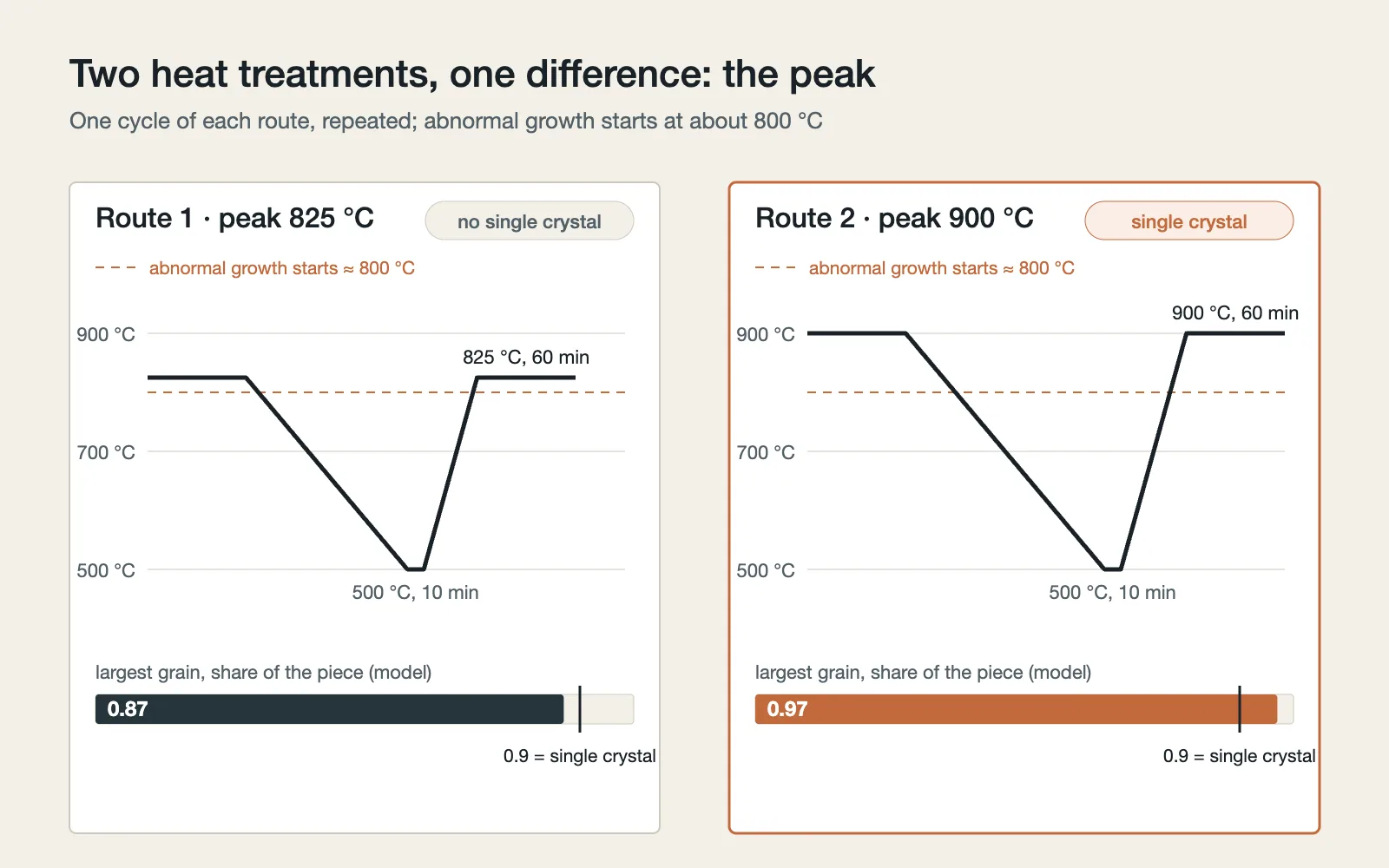
Two cyclic heat treatments of a copper alloy are alike except for how hot they get at their peak. Which one turns a piece made of many small crystals, its grains, into one single crystal? And which grain takes over?
The result
Run with published values for this kind of alloy, our engine's model says the route that peaks at 900 °C makes a single crystal and the route that peaks at 825 °C does not: the largest grain grows to 0.97 of the piece at 900 °C, and to 0.87 at 825 °C, just short of the 0.9 that counts as a single crystal.
Before the partner's images were opened, our team wrote down, from the engine's model, which grain would win: not the largest, and not the one holding the most stored energy, but the one whose crystal best lines up with a preferred direction set by how the sample was made.
In a copper alloy (Cu-Mn-Al), our engine explains which grain orientation takes over when the metal is heated, and a research partner's images bear it out: after 900 °C one orientation wins, after 825 °C none does.
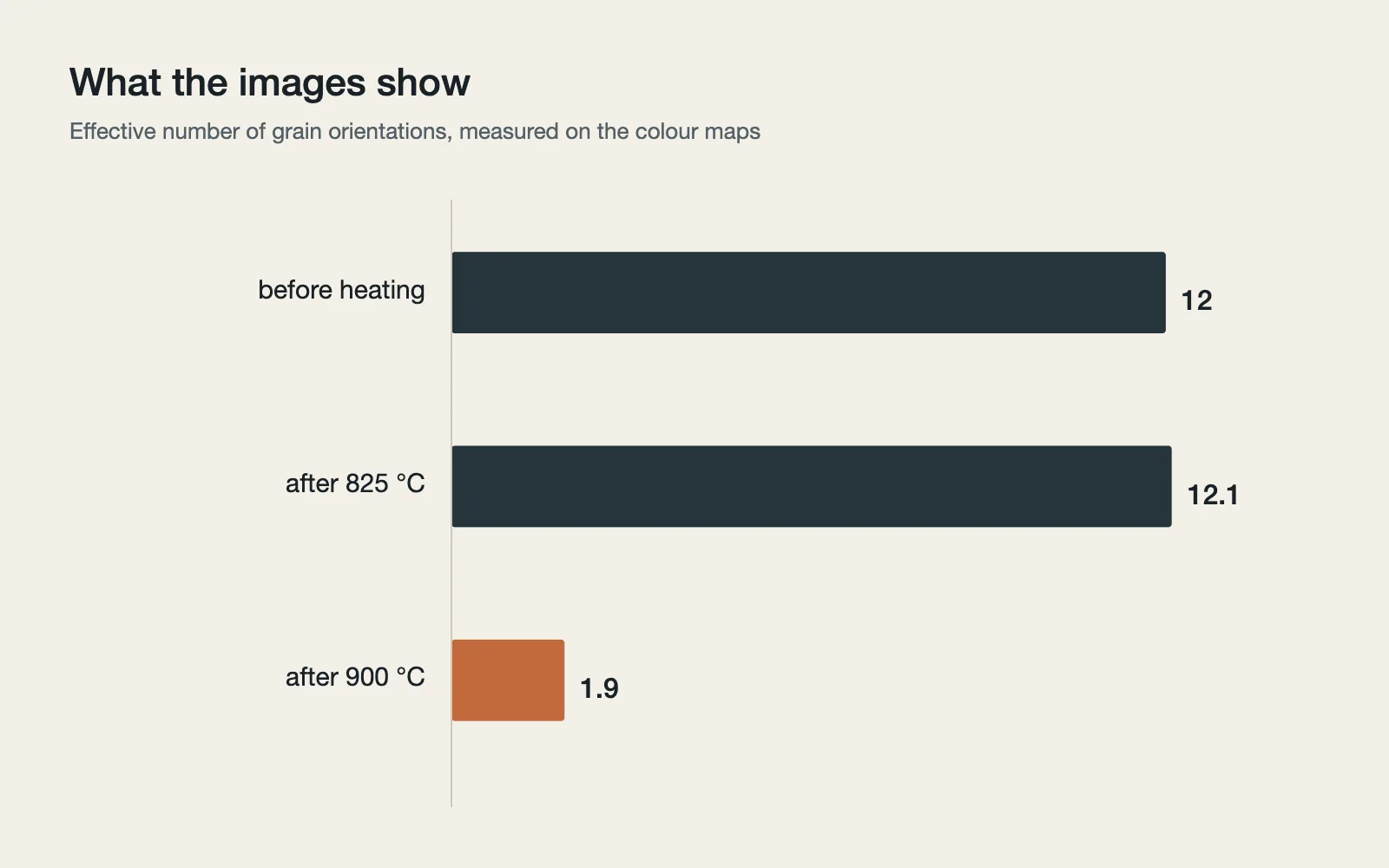
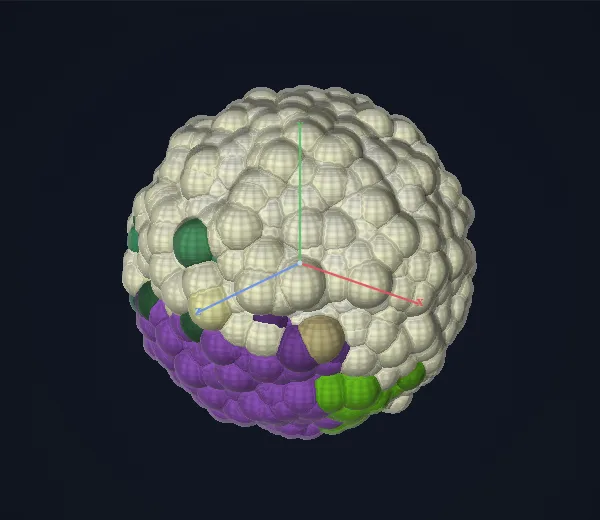
We measured the colours of the partner's images, where each colour stands for one crystal direction. After 900 °C, the effective number of orientations falls from about 12 to 1.9, and 99 % of the coloured area shows one orientation, lined up with the sample's reference direction. After 825 °C, the number stays at 12.1, as before heating.
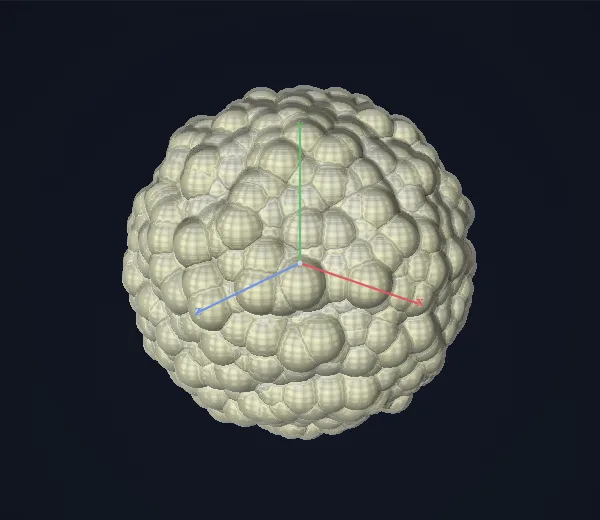
A second version of our engine's model, matched to the images, reproduces both: once the grain boundaries are free to move, the best-aligned grain takes over the whole piece, in 12 of 12 runs; with most boundaries held in place, the piece stays many grains, and the largest fills 5 % of it.
Why 825 °C falls short is not settled, and the record holds two explanations. With published values, the alloy's fine particles dissolve on both routes, and 825 °C lies only just above the temperature where abnormal growth starts, about 800 °C. The later explanation, matched to the images, holds that at 825 °C some of the particles remain and hold the grain boundaries in place, while at 900 °C they dissolve completely and free them.
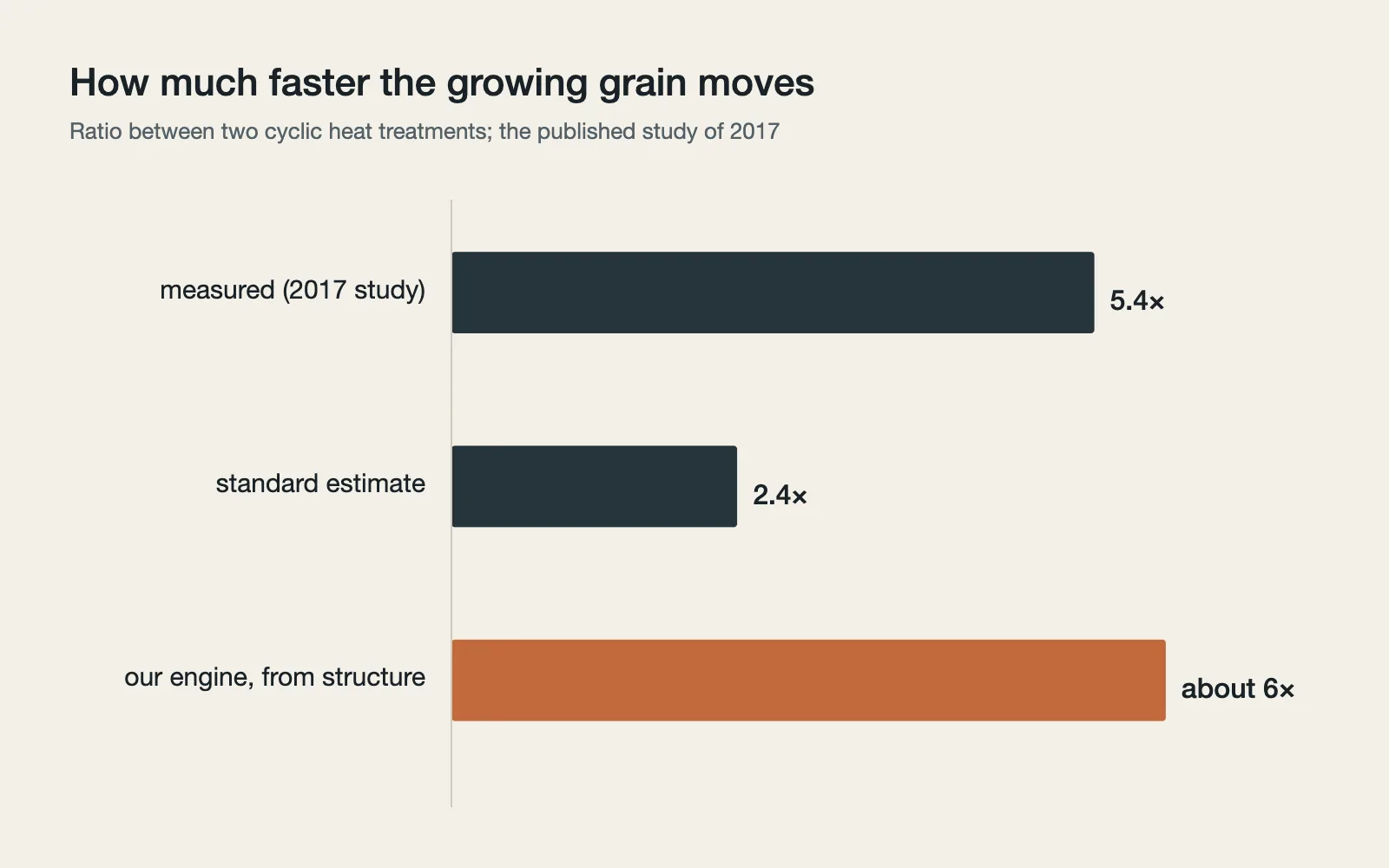
A published study of the same kind of alloy, "Ultra-large single crystals by abnormal grain growth" (2017), measured a growing grain moving 5.4 times faster after one cyclic heat treatment than after another; the standard estimate gives about 2.4 times. From the measured structure alone, never from the speeds, our engine accounts for about 6 times.
The control
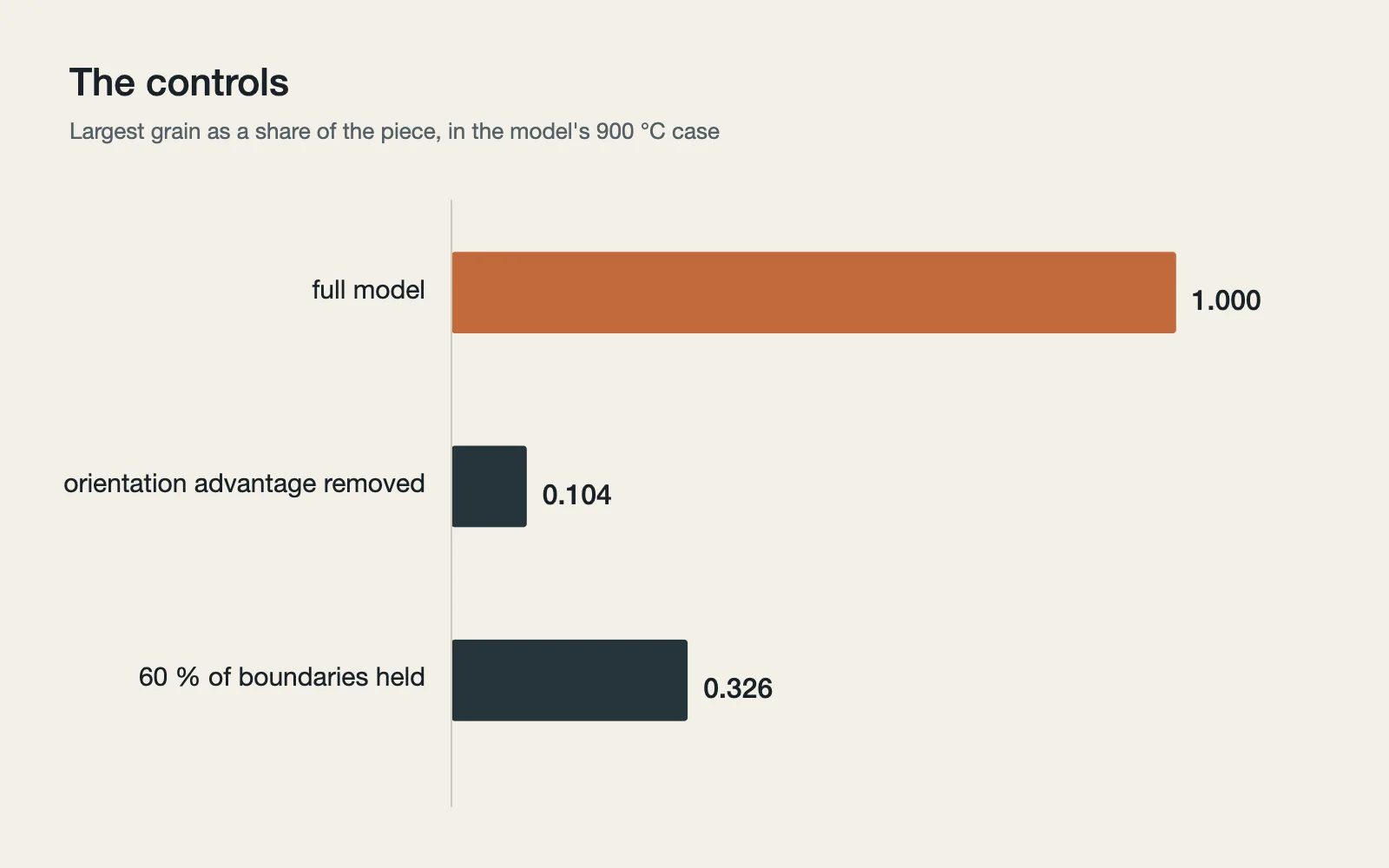
In the second model, take the orientation advantage away, and the 900 °C run stays many grains: the largest fills 10 % of the piece instead of all of it. Keep the advantage but hold 60 % of the boundaries, and no single crystal forms either: 33 %. The takeover holds across a twentyfold range of the advantage's strength.
The limit
The route model can only rank 900 °C above 825 °C; whether 825 °C falls short depends on its settings. Its 825 °C value lies within the noise of its generic time scale, so it cannot tell "no single crystal" from "a single crystal, very slowly". Its answer hinges on where growth starts: with the dissolving temperature, 726 °C, as that point, it gives 0.93 at 825 °C, a single crystal; moved to 830 °C, the share falls to 0.02. It gave its 825 °C answer before the 825 °C maps were seen, but with the expected outcome known.
The hypothesis was written down the day before the images were opened, but it was not among the predictions frozen that morning, which named a different cause and agreed with it only that the largest grain would not win. It named no particular crystal direction; that came from the images, which had been in hand all along.
The images are colour maps, not the raw measurements behind them, and they cover two temperatures, not a range.
We read the orientations from the colours with the standard colour key assumed. Before heating, the count was 10.4 to 12.6. The engine's model is told the sample's reference direction.
In the second model, the two temperatures are two settings, not a temperature scale: for 825 °C, the orientation advantage is switched off and 60 % of the boundaries are held. It shows that the explanation fits the images; it does not work out from a temperature which outcome follows.
The explanation was revised more than once as published values came in, and the two in the record disagree on whether the particles dissolve at 825 °C. The later one needs a dissolving temperature of about 865 °C, inferred from the partner's own result: a consistency check, not an independent test. The published value for a similar alloy is 726 °C. Absolute temperatures need one measured value as an anchor: a measurement of when the particles dissolve in this alloy, and of how fast its grains grow at each temperature, would settle it.
In the speed result, the engine's two measures fixed in advance came out higher, 7.5 and 8.3 times, because of one modelling choice; the about 6 times is the part without it. A third measure did not contribute. It is an interpretation the data supports, not a derivation.
Data and licence
The data: a research partner's colour maps of the grains' crystal directions, measured in an electron microscope, for the two routes: a peak hold of 60 minutes at 825 °C or 900 °C, cooling at 3.3 °C per minute to 500 °C, 10 minutes there, and reheating at 10 °C per minute. The published values and speeds: Kusama et al., "Ultra-large single crystals by abnormal grain growth", Nature Communications 8, 354 (2017).
Whom to talk to
Questions about this study, or a problem like it in your field: write to us.