
When a filled plastic starts to conduct
The amount of conductive filler at which a plastic turns from insulator into conductor, and what that costs in hardness.
Method note
The question
At what amount of filler do the conductive particles in a plastic first link up into an unbroken chain from one side to the other, so that the plastic starts to conduct?
And what does that filler cost in hardness?
The result
Long, thin particles need far less filler than round ones. With nothing tuned to match, the engine reproduces the textbook law for this: double the particles' length-to-width ratio and the threshold roughly halves. The slope comes out at −0.95, where theory says −1.
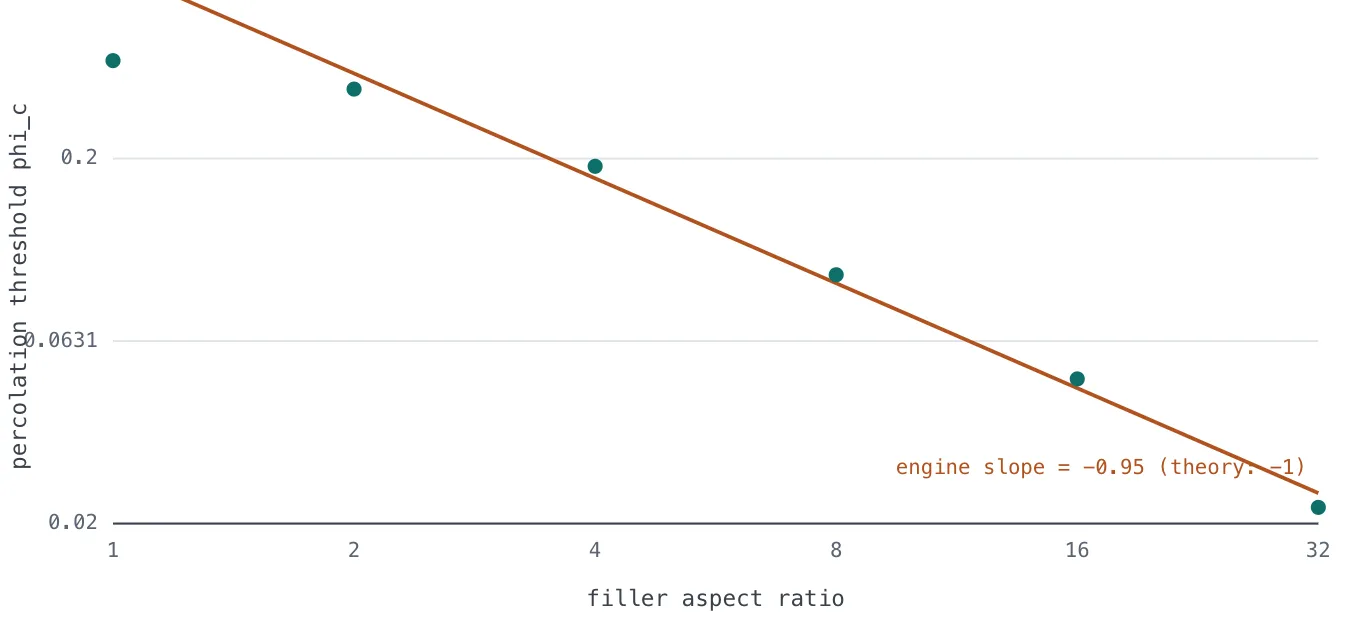
From round particles to rods 32 times as long as they are wide, the threshold drops 16.8-fold, from 0.37 to 0.022 of the volume.
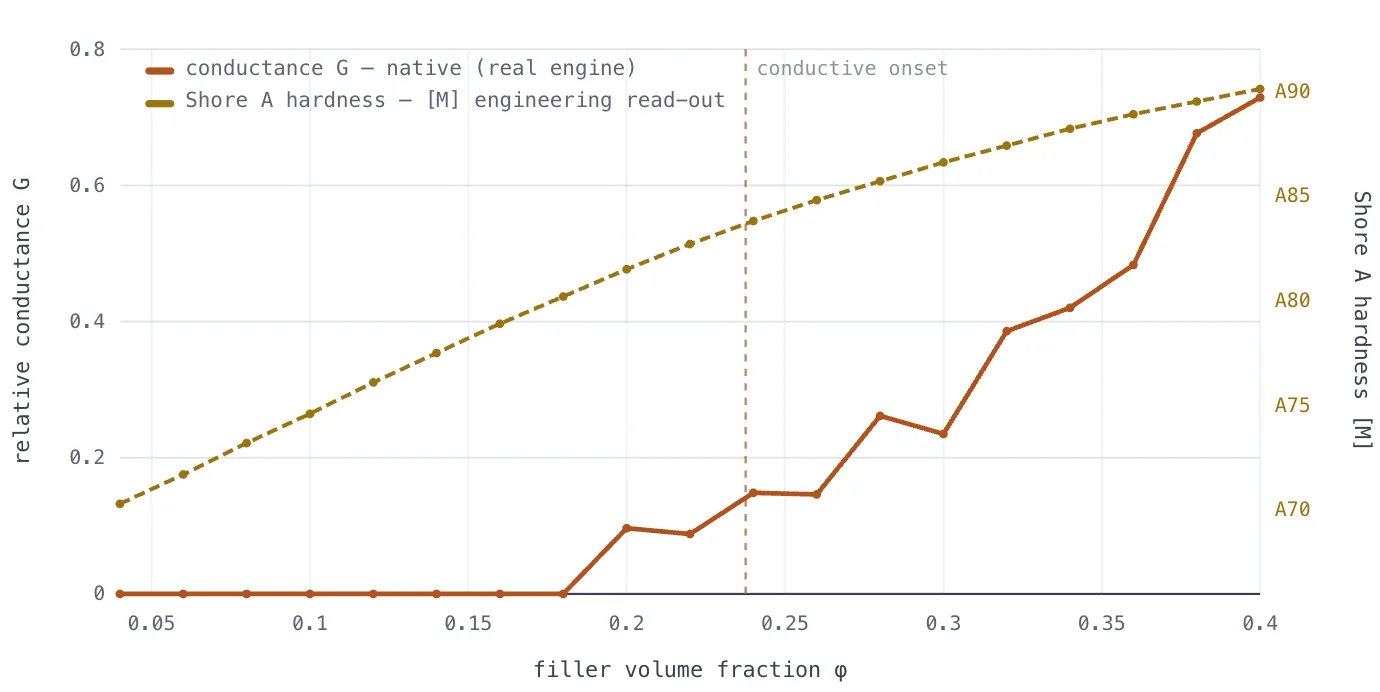
The filler that makes a plastic conduct also makes it harder. In a model soft plastic, reaching the point where it starts to conduct (about 0.24 of the volume) raises the hardness from about Shore A 68 to A 84, and the stiffness from 5 to about 12 MPa. There is no single best recipe, only a trade-off.
The control
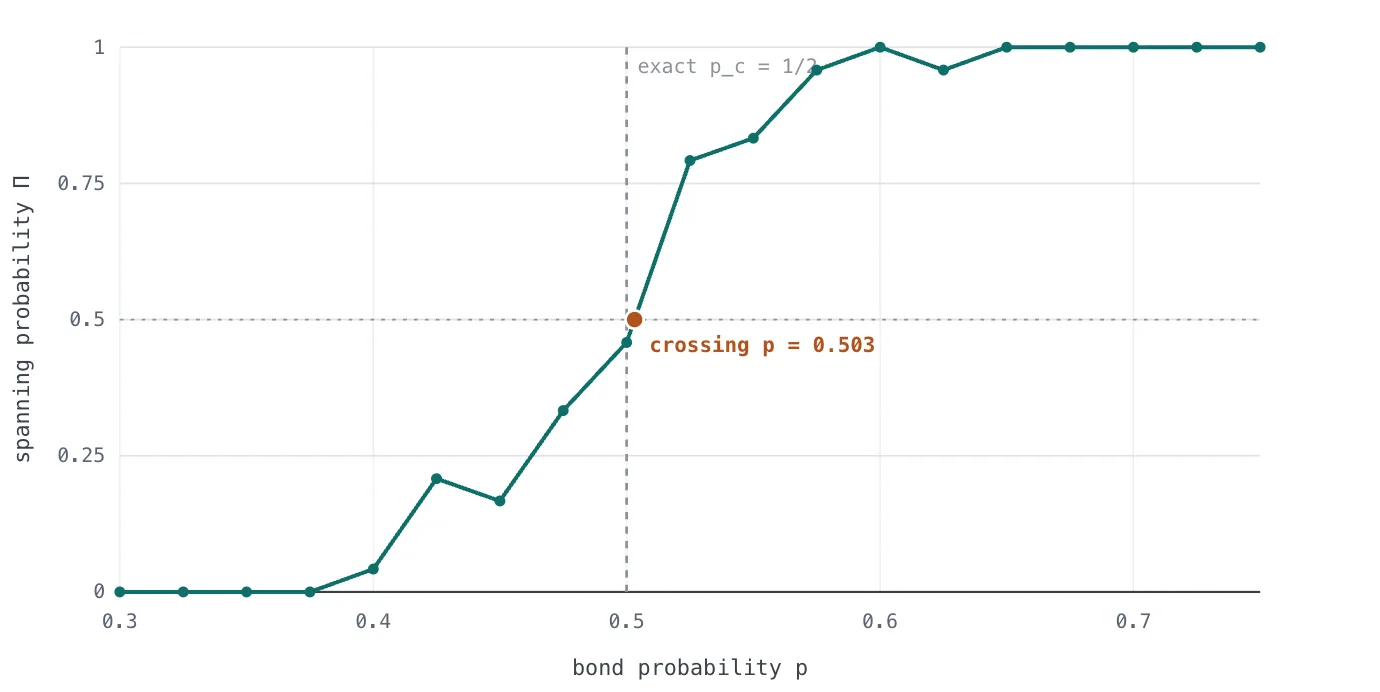
Before trusting the method on a plastic, we checked it where mathematics knows the answer exactly. A square grid whose links are each present by chance connects from one side to the other at a share of exactly one half. With no fitting, the engine finds that tipping point at 0.503, against the exact 0.500; an independent program finds 0.505.
A separate program, written without our engine and with its own random numbers, reproduces the law with a slope of −1.06. Rerunning the engine gives byte-identical output.
The limit
What is shown is the law and the order of the shapes. The threshold value itself depends on the model's particles and on when two of them count as touching; it is not a prediction for any real filler. The slope is read from the ratios 2 to 32.
Hardness and stiffness here come from standard published rules of thumb, applied to an assumed soft plastic with a stiffness of 5 MPa. They are not the engine's own physics, not measured, and not tuned to any product. The conductance is relative, not in absolute units.
The grid check runs on an ideal flat grid of 16 by 16, with 24 random grids at each share. It tests the method, not a plastic.
Nothing here has yet been tested against a partner's measurements of a real plastic. Three predictions are open for such data to test: the threshold should fall sharply for rod- and plate-shaped fillers; the resistance should collapse where the particle network first connects through; and hardness should rise with filler along the standard rule, within the usual scatter.
Data and licence
The data: particle networks and grids the engine generated itself. The law, the grid check and the trade-off come from recorded runs whose outputs are fixed by checksums. No partner or product data was used.
Whom to talk to
Questions about this study, or a problem like it in your field: write to us.